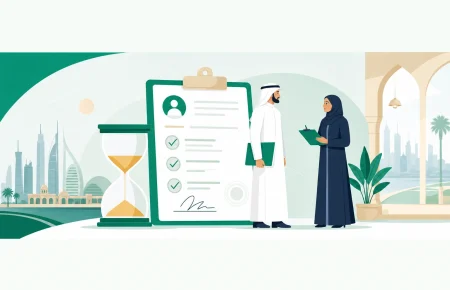

Living and working in Saudi Arabia requires expatriates to navigate a digital-first immigration framework where physical paperwork has been almost entirely replaced by electronic portals. At the core of this system are Absher and Muqeem, two distinct yet interconnected government platforms operated under the supervision of the Ministry of Interior and the General Directorate of Passports, known locally as Jawazat. Whether you are an arriving professional, a resident sponsoring family members, or an employee planning international travel, knowing which platform handles your residency permits, travel authorizations, and official records is essential for remaining legally compliant and avoiding severe administrative penalties.
Key Takeaways
- Absher Individuals is your personal portal for managing your digital identity, renewing family sponsorships, checking traffic files, and requesting personal travel visas.
- Muqeem is an enterprise-level platform used by employers to issue work Iqamas and exit re-entry permits, though expats routinely use its public tools to verify visa status and request official resident reports.
- Expats cannot log into the corporate Muqeem portal directly, but they must know how to pull official 30-day Muqeem Prints through HR for banking, school admissions, and embassy visa filings.
- Under Saudi Arabia’s Labor Reform Initiative, expatriates can submit exit re-entry and final exit requests independently through Absher if their employment contract conditions are met.
- Routine checks of your Iqama validity, dependent fees, and passport data across both systems prevent sudden bank account freezes and border delays.
Understanding the Saudi Digital Immigration Ecosystem: Absher vs. Muqeem
Many expatriates arrive in the Kingdom of Saudi Arabia assuming that Absher and Muqeem are interchangeable terms for the same government system. In practice, they serve separate administrative functions within the Ministry of Interior’s electronic architecture, which is developed and supported by Elm, the Kingdom’s digital solutions provider. Conflating the two platforms frequently causes confusion when foreign workers attempt to process travel visas or resolve residency status discrepancies.
Absher is primarily a citizen and resident portal. It ties directly to a single National ID or Iqama number and serves as the personal gateway to government services. Every expatriate who holds a valid residency permit must register and authenticate their own Absher Individuals account using biometric self-service kiosks or online banking verification. Absher also operates a specialized tier called Absher Business, but that version is restricted to sole proprietorships and establishments employing 100 or fewer workers.
Muqeem, by contrast, is an institutional workforce management platform. Built specifically for medium and large corporate entities, government authorities, and multinational enterprises operating in Saudi Arabia, Muqeem connects a company’s Commercial Registration or Unified Entity Number directly to Jawazat. Human resources departments, government relations officers, and authorized company representatives use Muqeem to oversee hundreds or thousands of foreign employee records simultaneously. An individual foreign worker does not receive an individual login for Muqeem; instead, your employer executes institutional transactions on your behalf through their corporate subscription.
| Feature / Dimension | Absher Individuals | Muqeem Portal |
|---|---|---|
| Target User | Individual residents (expats) and Saudi citizens | Establishments, HR managers, and corporate PROs |
| Access Identifier | Personal Iqama number and authenticated mobile line | Establishment Commercial Registration (CR) and 700-number |
| Primary Functions | Family visas, digital ID, driving records, personal requests | Batch workforce Iqama renewals, corporate visas, employee audits |
| Cost to Expatriate | Free account access (government service fees apply) | Free public lookup; corporate subscription paid by employer |
| Exit/Re-Entry Scope | Direct issuance for dependents; personal requests to employer | Direct issuance, extension, and cancellation for all sponsored staff |
Essential Absher Services Every Expatriate Must Master
Your Absher Individuals account functions as your legal anchor while residing in Saudi Arabia. From the moment your physical Iqama is processed, your digital existence in the Kingdom is mirrored inside this portal, accessible via the official website or the mobile application.

Digital Iqama and the Absher Digital Wallet
Carrying a physical plastic Iqama card at all times used to be mandatory, with fines levied for failing to present it upon request by law enforcement. Jawazat resolved this through the digital resident identity card embedded directly in the Absher Individuals mobile app. Once authenticated, your digital identity is stored securely on your smartphone and includes an encrypted QR code. Saudi police patrols, checkpoint authorities, and financial institutions accept this digital card as an official, legally recognized proof of identity, even when your phone lacks an active internet connection.
Dependent Sponsorship and Family Visa Management
Expatriates who sponsor family members under their personal Iqama rely on Absher Individuals to act as the family’s administrative sponsor. While your employer handles your corporate sponsorship, you bear full legal responsibility for your dependents. Through Absher, you can:
- Issue and renew Iqamas for your spouse and children following payment of the required dependent levy through your bank’s SADAD portal.
- Issue single and multiple exit re-entry visas for your dependents before school breaks or holiday travel.
- Cancel unused family travel visas within the official cancellation window to prevent statutory fines.
- Extend the exit re-entry visa of a family member who is currently outside the Kingdom, provided their Iqama remains valid for at least 90 days.
Independent Travel Requests Under the Labor Reform Initiative
Historically, foreign employees could not travel abroad without their employer manually issuing an exit re-entry permit. Following the Ministry of Human Resources and Social Development’s Labor Reform Initiative, private-sector workers bound by an authenticated digital contract on the Qiwa platform can now request their own exit re-entry visa or final exit visa directly through Absher under the ‘Visa Requests’ service. When an employee submits a single exit re-entry request on Absher, the platform notifies the employer electronically. If the employer does not respond or register an official objection within the statutory 10-day notification period, the system permits the employee to complete the visa issuance autonomously, granting greater mobility within the legal bounds of the Saudi labor system.
Traffic, Licensing, and Civic Services
Beyond residency and travel, Absher handles daily civic interactions. Expatriates use the portal to book driving license appointments, renew existing driving permits, update vehicle registration cards (Istemara), and check real-time traffic infractions captured by automated monitoring systems (Saher). Crucially, Absher also links directly to the National Address Register (SPL), ensuring that all official government and judicial notifications delivered to your digital inbox carry legally binding status.
Tip: Always maintain your active Saudi mobile number on Absher. Because two-factor authentication codes (OTP) govern access to government portals, banking systems, and medical health records, losing access to your registered mobile number locks you out of nearly all essential public transactions.
Critical Muqeem Services and Public Tools Expats Rely On
Even though expatriates do not possess administrative login privileges for the corporate Muqeem system, their daily lives are deeply affected by transactions processed through it. Furthermore, Muqeem provides vital public services that require no login credentials at all.
The Public Muqeem Visa Validity Tool
One of the most valuable resources for any foreign worker in Saudi Arabia is the open-access Visa Validity Service hosted on the official Muqeem portal. Once your employer issues an exit re-entry or final exit visa, you should never board an aircraft or cross a land border relying solely on verbal confirmation. By visiting the public visa check tool, you can verify your exact legal status in seconds.
To check your visa without an account, navigate to the public verification screen and select your identifier: either your 10-digit Iqama number or your Border Number (for new arrivals awaiting their initial Iqama). You then match this identifier with a secondary data point, such as your visa number, passport number, full name, or date of birth. The system instantly returns your official Jawazat record, displaying whether the visa is ‘Valid’, ‘Used’, ‘Expired’, or ‘Cancelled’. It also provides the exact ‘Return Before’ date or the authorized duration in days, allowing you to plan your travel and avoid overstaying.
The Official Muqeem Print (Resident Report)
In various administrative scenarios, external authorities require verified documentation of your legal standing in the Kingdom that goes beyond what is displayed on your plastic Iqama card. Known widely as a ‘Muqeem Print’ or ‘Muqeem Paper’, this document is an official electronic report generated by an employer through the Muqeem portal (or by an individual sponsor via Absher Reports for dependents).
A standard Muqeem Report consolidates your full administrative history: your full legal name, nationality, passport details and validity dates, Iqama issuance and expiry dates, labor profession code, basic health insurance policy status, and your employer’s unified 700-number. Crucially, every Muqeem Print carries a unique verification reference number and is valid for exactly 30 days from issuance. Foreign embassies issuing Schengen or UK visas from Riyadh or Jeddah, mortgage lenders, vehicle leasing agencies, and international schools require this document to ensure your residency remains in good standing.
Updating Passport Details (Naql Maloomat)
When you renew your passport at your home country’s embassy or consulate in Saudi Arabia, your legal residency record still reflects your old passport number. To align your border records and allow trouble-free international departure, your employer’s government relations team must execute a passport data update, known as Naql Maloomat, through the Muqeem portal. Once completed on Muqeem, your new passport details reflect almost instantaneously across Absher and border control terminals.
Muqeem Arrival Registration for Incoming Travelers
For newly hired expatriates traveling to Saudi Arabia for the first time on an employment entry visa, as well as visitors on commercial or family visit visas, the Muqeem Arrival Registration platform remains an important compliance checkpoint. Employers and arriving individuals use this public portal prior to departure to register basic traveler data and border crossing details, ensuring smooth clearance through immigration checkpoints at King Khalid International Airport, King Abdulaziz International Airport, and other border points.
Step-by-Step: Managing Family Visas and Travel on Absher
If you sponsor your family members in Saudi Arabia, issuing their exit re-entry permits is entirely in your hands as their primary sponsor. Follow this structured process to issue travel visas correctly through Absher Individuals:
- Settle government visa fees via SADAD. Log into your Saudi online banking app, navigate to Government Payments (MOI), select ‘Alien Control’ or ‘Passports’, and choose ‘Exit Re-Entry Visa (Single or Multiple)’. Input your dependent’s Iqama number. The standard statutory fee for a single exit re-entry visa is SAR 200 for up to two months, plus SAR 100 for each additional month. Multiple-entry visas cost SAR 500 for up to three months, plus SAR 200 for each additional month.
- Audit passport and Iqama validity. Ensure your dependent’s passport has at least three months of remaining validity for single-entry travel or six months for multiple-entry travel. The dependent’s Iqama must be valid for at least the full duration of the requested visa plus an additional administrative buffer.
- Clear outstanding traffic penalties. The Ministry of Interior’s automated gateway blocks visa issuance if either the sponsor or the dependent has unpaid traffic violations. Review your traffic file on Absher and clear any fines prior to launching the visa request.
- Execute the issuance on Absher Individuals. Log into your Absher account, select ‘Family Members Services’, click on ‘Visa Services’, and choose the specific family member. Select ‘Issue Exit Re-Entry Visa’, confirm whether you wish to specify a return-before date or a duration in days, review the summary, and confirm.
- Save and archive the electronic visa slip. Absher generates an electronic visa document containing the official visa number, QR verification code, and departure window. Download and save the PDF. While border control scans your digital record directly via passport barcode, having an electronic copy on hand prevents boarding issues with international airlines unfamiliar with Saudi digital visas.
Navigating Friction Points: Common Errors, Fines, and How to Resolve Them
Administrative errors on Absher or delays by your employer’s Muqeem administrator can result in steep financial penalties or legal status complications. Understanding where processes typically break down helps you protect your residency rights.
Expired Iqama and Late Renewal Penalties
Under Jawazat regulations, an Iqama must be renewed before its official expiration date. Employers are legally responsible for renewing employment Iqamas, while expatriates must renew those of their dependents. According to the General Directorate of Passports, failing to renew an Iqama within the three-day grace period following expiry incurs a statutory fine of SAR 500 for the first offense, doubling to SAR 1,000 upon a second offense. Repeated non-compliance risks cancellation of the residency permit and potential deportation. Furthermore, an expired Iqama triggers an automated freeze on your Saudi personal bank accounts within 30 to 60 days, halting debit card usage and electronic salary transfers.
Unused Exit Re-Entry Visas
A frequent error occurs when an expatriate issues an exit re-entry visa for themselves or a family member, cancels the planned trip, and simply lets the visa expire without formal cancellation. An exit re-entry visa remains valid for travel within the specified ‘Exit Before’ date (typically 30 to 90 days from issuance). If travel plans change, the sponsor must actively cancel the issued visa through Absher or Muqeem prior to that departure deadline. Allowing an unused exit re-entry permit to expire without traveling or canceling results in a SAR 1,000 fine under Jawazat regulations.
Overstaying Abroad and the ‘Exited and Did Not Return’ Trap
If an expatriate employee or family member departs on an exit re-entry visa and fails to return to Saudi Arabia before the authorized return date, their status changes automatically in Jawazat records to ‘Kharaj Wa Lam Ya’ud’ (Exited and Did Not Return). In previous years, this status carried an automatic three-year entry ban for workers attempting to re-enter on a new commercial employment visa. While Saudi authorities relaxed this restriction to allow workers to return on a new visa with fewer punitive hurdles, allowing a visa to lapse while abroad still cancels your active Iqama immediately and complicates future administrative records. Always use Absher or have your employer use Muqeem to extend the visa online before the return window closes.
Warning: When an exit re-entry visa states a duration in days (for example, ’90 days’), the countdown begins on the exact date you pass through Saudi passport control at departure, not the date the visa was generated on the portal. Conversely, if the visa specifies a fixed calendar return date, you must return before that precise date regardless of when you left.
Example scenario (illustrative)
Tariq, a civil engineer in Dammam, planned a six-week annual leave with his family starting July 1. In early June, his company issued his single exit re-entry visa through Muqeem, while Tariq logged into his personal Absher account, paid the SADAD fees, and issued matching visas for his wife and daughter.
Two days before departure, Tariq used the public Muqeem Visa Validity Tool to double-check all three visa files. The system showed his dependents’ visas were ‘Valid’, but his own record flagged an administrative hold: his company had renewed his employment contract on Qiwa, but the HR officer had forgotten to finalize the passport data update on Muqeem following Tariq’s recent passport renewal. Because he caught the mismatch early using the free Muqeem tool, his company’s government relations officer completed the Naql Maloomat on Muqeem within two hours, preventing a disastrous refusal at the King Fahd Causeway border control.
Practical Checklist for Expatriate Digital Compliance
To ensure your stay in the Kingdom remains free from administrative obstacles, integrate this digital maintenance routine into your professional and personal schedule:
- Verify that your Absher Individuals account is fully active and paired with your primary personal mobile number registered under your own Iqama.
- Inspect your Absher Digital Wallet every quarter to confirm that your digital resident identity and driving license records reflect correct validity dates.
- Run a public Muqeem Visa Validity check on muqeem.sa before booking international flights for yourself or your family members.
- Ensure any newly issued passport is updated in the Jawazat system via your employer’s Muqeem portal (or via Absher for dependents) before traveling abroad.
- Request an official Muqeem Print from your employer’s HR team at least two weeks before submitting visa applications to foreign embassies or processing local bank financing.
- Monitor your dependent Iqama expiration dates at least 60 days in advance to budget for the dependent levy and complete renewals before grace periods elapse.
- Confirm that all personal traffic citations are settled immediately to prevent automated transaction freezes across government portals.
Verify before you act: Immigration guidelines, dependent levy schedules, and digital portal workflows in Saudi Arabia are subject to ongoing modernization under Vision 2030 initiatives. Always verify specific procedural changes and fee structures directly through the Ministry of Interior’s official Absher portal or the General Directorate of Passports (Jawazat) before initiating financial transfers or booking non-refundable travel.
Conclusion
Mastering the distinct roles of Absher and Muqeem transforms Saudi Arabia’s digital immigration system from a source of administrative anxiety into a dependable, transparent tool. Your Absher account gives you direct autonomy over your personal identity, domestic civic affairs, and family travel, while Muqeem handles the institutional machinery that keeps your employment residency legally verified behind the scenes. Your most effective next step today is to log into your Absher dashboard to check your dependent records and run a quick verification of your current visa status on the public Muqeem portal.
Frequently Asked Questions
Can an individual expat employee create a personal login account on Muqeem?
No. The Muqeem portal is strictly an institutional B2B platform reserved for licensed commercial establishments, corporations, and government bodies. Individual expatriates manage their personal government affairs through Absher Individuals, but they can freely use Muqeem’s public, unauthenticated tools to verify visa validity and border arrival status.
What is the difference between an Absher Report and a Muqeem Print?
Both documents provide an authenticated electronic record of a resident’s immigration status that remains valid for 30 days and carries a reference verification code. An Absher Report is issued by an individual resident for themselves or their sponsored dependents, whereas a Muqeem Print is generated by an employer through Muqeem to provide verified company sponsorship and profession details often required by banks and embassies.
Can an expatriate issue their own exit re-entry visa without employer intervention?
Yes, under the Labor Reform Initiative, private-sector employees with authenticated digital employment contracts on Qiwa can submit an exit re-entry visa request directly through Absher Individuals. The employer receives an electronic notification, and if no legitimate objection is filed within 10 days, the visa can be issued through the portal.
How do I check if my exit re-entry visa is still valid without logging into Absher?
Visit the official Muqeem website (muqeem.sa), select the public Visa Validity Service, and enter your 10-digit Iqama or Border number alongside a secondary matching data point such as your visa number or passport number. The platform immediately displays the real-time status as Valid, Used, Expired, or Cancelled along with authorized travel dates.
What happens if an expat renews their passport but does not update it on Muqeem?
If an expat renews their passport and attempts to travel abroad without transferring the data (Naql Maloomat) via Muqeem, airport immigration will find a mismatch between the resident’s active Iqama and the physical passport presented. This mismatch typically causes severe delays or outright refusal of international boarding until the employer’s PRO updates the system.
Last updated: November 2026. For laws, fees, salaries and procedures, confirm the latest details with the relevant official authority or your employer.