
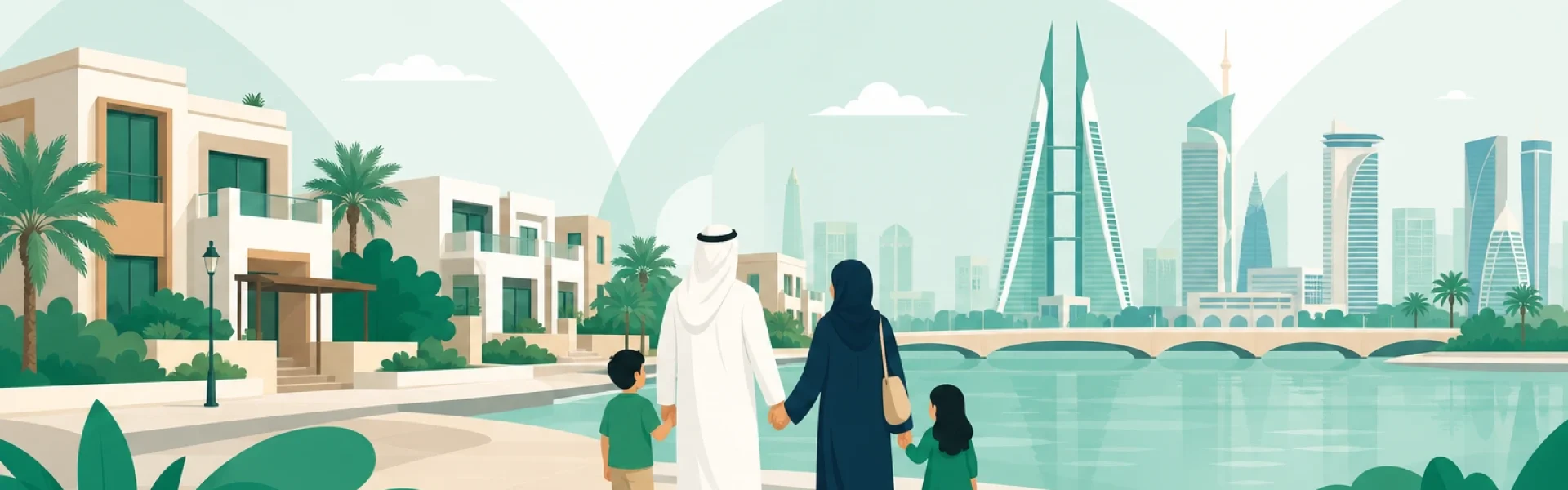
The best areas to live in Bahrain depend primarily on your household structure, workplace location, and whether your daily routine involves international schooling or commuting across the King Fahd Causeway to Saudi Arabia. Expat families typically settle in suburban villa compounds in Saar, Janabiya, and Riffa Views for their generous outdoor space and proximity to top British and American schools, while single professionals and couples often choose high-rise apartments in Juffair, Seef, and Amwaj Islands for quick commutes and vibrant amenities. This guide offers international assignees, regional transferees, and relocating families an objective, practical breakdown of Bahrain’s top residential districts, contractual rental norms, and neighborhood decision criteria.
Key Takeaways
- Saar and Janabiya remain the premier choices for expat families requiring standalone villas, gated compound living, and immediate access to top tier international schools and the Saudi Causeway.
- Juffair, Seef, and Reef Island cater heavily to corporate professionals seeking furnished modern apartments, hotel-grade amenities, and minimal travel time to Manama’s core commercial towers.
- Amwaj Islands and Diyar Al Muharraq offer master-planned, resort-style waterfront living with designated freehold zones where expatriates can both lease and acquire residential property.
- Bahrain’s Property Rent Law (Law No. 27 of 2014) mandates formal lease contract registration on the National Portal (bahrain.bh) to secure tenant protections before the Rent Disputes Committee.
- Rental contracts in Bahrain are commonly negotiated as either ‘inclusive’ (utilities and municipal fees covered up to an agreed cap) or ‘exclusive’ (tenant pays actual billing directly).
Top Residential Areas for Expat Families: Compounds, Space, and Schools
For expatriate families relocating to the Kingdom, residential priorities almost always center on gated community security, shared leisure facilities like pools and tennis courts, and reasonable morning school runs. Bahrain is exceptionally family-oriented, but peak-hour traffic bottlenecks along major arteries such as Shaikh Isa bin Salman Highway and Budaiya Highway mean that living on the wrong side of your children’s school can add substantial travel time to your daily routine.
Saar: The Traditional Expat Family Heartland
Saar is widely regarded as the cornerstone of expat family life in Bahrain. Located in the Northern Governorate just ten kilometers west of Manama, Saar consists largely of leafy residential compounds, standalone private villas, and low-density developments. Expat families gravitate here because of its relaxed suburban atmosphere and close proximity to major educational institutions, including St Christopher’s Junior School in Sar and the British School of Bahrain in neighboring Hamala. The district is fully serviced by family-focused retail hubs like Saar Mall, Mercado Mall, and Nakheel Centre, alongside sports clubs such as the Dilmun Club and the Bahrain Rugby Football Club, which serve as central social anchors for European and Commonwealth expatriates.
Janabiya: Modern Compounds and Causeway Commuting
Directly bordering Saar to the west, Janabiya has developed rapidly into an upscale residential enclave of newly constructed, high-specification compounds. It is particularly popular among professionals who live in Bahrain while commuting daily across the King Fahd Causeway to Khobar or Dammam in Saudi Arabia’s Eastern Province. Living in Janabiya allows commuters to bypass internal city traffic and access the causeway checkpoint in under ten minutes during off-peak hours. The neighborhood features convenient retail and dining plazas, such as El Mercado Janabiya, alongside equestrian centers, pet boarding facilities, and specialized nurseries, making it an intuitive transition for relocating households.
Riffa and Riffa Views: Space, Value, and Gated Exclusivity
Situated in the south-central portion of the main island, Riffa is divided into East and West Riffa. While traditional Riffa is predominantly inhabited by Bahraini nationals, the premier destination for international families is Riffa Views. This upscale, master-planned gated development is built around the Colin Montgomerie-designed championship golf course at the Royal Golf Club. Riffa Views is divided into three distinct architectural sectors: the Lagoon, the Park, and the Oasis. The development houses Riffa Views International School (RVIS), offering an American-curated curriculum that makes it a top consideration for North American and corporate management families. Homes here offer larger private gardens than equivalent properties in the north, although residents must account for a 20- to 30-minute drive into central Manama.
Diyar Al Muharraq: Modern Waterfront Communities
Located on the northeast coast of Muharraq Governorate, Diyar Al Muharraq represents modern master-planned living. This expansive development includes residential sub-communities like Marassi Al Bahrain, which integrates luxury beachfront townhouses and apartments with direct access to Marassi Galleria shopping mall. Diyar is increasingly favored by families who value a pedestrian-friendly environment, pristine beaches, and modern infrastructure. It also hosts several prominent private institutions, including the Canadian School Bahrain and Noor Al Diyar Private School, providing strong educational options within walking distance of modern coastal housing.
Note: If you plan to live in Bahrain and commute to work in Saudi Arabia, prioritize Janabiya, Saar, or Jasra. Choosing eastern areas like Juffair or Muharraq can easily add 45 to 60 minutes of congestion to each leg of your daily causeway transit.
Best Neighborhoods for Working Professionals and Singles
Single executives, young couples, and project-based consultants relocating to Bahrain frequently prioritize convenience, on-site fitness facilities, diverse dining, and proximity to office headquarters. Unlike suburban compounds, urban neighborhoods in Manama feature high-density vertical living, where properties are overwhelmingly leased on a fully furnished basis with private parking stalls and 24-hour building security.
Juffair: The High-Energy Social Hub
Juffair is situated along Manama’s eastern coastline and represents the most concentrated hub of expat-oriented high-rise apartments in the country. Home to the United States Naval Support Activity (NSA) Bahrain, Juffair offers a bustling urban lifestyle lined with international restaurant chains, hotels, supermarkets like Lulu Hypermarket, and active nightlife. The district features an extensive inventory of one- and two-bedroom modern apartments equipped with rooftop pools, squash courts, steam rooms, and housekeeping services. Rental costs in Juffair remain competitive due to abundant supply, making it an excellent landing spot for newly arrived professionals seeking turn-key housing without committing to buying furniture or driving long distances for basic errands.
Seef District: Corporate Convenience and High-End Retail
Seef is Bahrain’s primary commercial, financial, and retail district outside of the historical central business district. Dominated by gleaming office towers, international audit firms, luxury hotels, and Bahrain’s largest shopping centers—including City Centre Bahrain and Seef Mall—the neighborhood is tailor-made for corporate executives who prefer a minimal commute. Residential options in Seef consist primarily of mid-rise and luxury high-rise towers offering sea or skyline views. The environment is more corporate and orderly than Juffair, offering an upscale alternative for professionals who want walking-distance access to their corporate offices and premium retail facilities.
Adliya: Creative Character and Culinary Vibrancy
For professionals who find high-rise towers sterile, Adliya offers an attractive, low-rise alternative rich in cultural character. Known as Bahrain’s bohemian and dining epicenter, Adliya is home to Block 338, a pedestrianized zone filled with international art galleries, independent coffee shops, and high-end bistros. Housing in Adliya comprises converted mid-century villas, older standalone houses, and renovated boutique apartment blocks. Rental rates are often more accessible than in Seef or Reef Island, attracting creative professionals, educators, and expats who appreciate architectural individuality and a vibrant, walkable neighborhood feel.
Waterfront and Luxury Living: Master Developments and Freehold Zones
Bahrain’s archipelago geography lends itself to ambitious reclamation projects designed to maximize sea views and private beach access. These master-planned communities are designated as investment zones under Bahraini real estate law, allowing non-Bahraini nationals to lease premium units or purchase property on a 100 percent freehold basis.
Amwaj Islands: Self-Contained Coastal Lifestyle
Situated off the northeastern coast of Muharraq Island, Amwaj Islands was Bahrain’s pioneer man-made residential project with full foreign freehold ownership rights. Amwaj functions as a virtually self-sufficient seaside suburb consisting of several sub-islands (Tala, Najmah, Asfpoor, and Murjan). Tala Island is particularly sought after by European and Western families for its secure gated access, manicured gardens, Mediterranean architecture, private beaches, and tennis facilities. Amwaj features The Lagoon, an open-air retail and dining boardwalk, alongside Alosra supermarket, American Mission Hospital clinic, and the International School of Choueifat. It offers a relaxed, resort-style atmosphere just eight minutes from Bahrain International Airport, though reaching downtown Manama during morning rush hours requires crossing Muharraq causeways.
Reef Island and Bahrain Bay: Executive Waterfront Prestige
For the pinnacle of central luxury apartment living, Reef Island and Bahrain Bay are unmatched. Reef Island is a private, gated residential island set directly in the harbor of Manama, moments away from Seef. It is characterized by quiet streets, landscaped promenades, fine dining venues, and boutique low-to-mid-rise apartment residences that offer absolute privacy in the heart of the capital. Directly across the water, Bahrain Bay hosts iconic architectural landmarks such as the Bahrain Financial Harbour, Four Seasons Hotel, and luxury residential developments like Waterbay. Expats residing here represent senior diplomats, financial executives, and regional management looking for world-class finishes and immediate access to Bahrain’s central executive corridors.
Comparing Bahrain’s Key Residential Areas
To assist in evaluating potential locations, the following table summarizes the primary living attributes, property types, and demographic focus across Bahrain’s top residential districts.
| District | Target Demographic | Predominant Housing Type | Commute Advantages | Lifestyle Character |
|---|---|---|---|---|
| Saar & Janabiya | Expat families & Saudi commuters | Gated compound villas & standalone homes | Immediate access to King Fahd Causeway; 15 mins to Seef | Suburban, green, school-centric, social clubs |
| Riffa Views | Golf enthusiasts & mid-to-senior expat families | Luxury 2 to 5-bedroom golf-course villas | Fast access to Alba, Bapco, and southern industrial hubs | Quiet, secure, upscale community with on-site schooling |
| Juffair | Single professionals, young couples, US Navy | Furnished 1 & 2-bedroom high-rise apartments | 10 mins to Diplomatic Area; easy airport highway access | Lively, bustling, active nightlife, highly commercialized |
| Seef District | Corporate managers & finance professionals | Modern serviced apartments & luxury towers | Walking distance to major commercial banks & malls | Metropolitan, business-centric, polished, high convenience |
| Amwaj Islands | Waterfront lovers, airport staff, expat families | Beachfront villas & sea-view apartments | 8 mins to airport; 25 mins to Manama Financial Harbour | Resort-style, nautical, self-contained coastal community |
| Reef Island | Senior executives, diplomats, luxury seekers | Gated boutique apartments & waterfront villas | 5 mins to Seef and Manama Financial Harbour | Exclusive, tranquil, manicured, private waterfront sanctuary |
| Adliya | Teachers, creatives, dining enthusiasts | Low-rise apartments & heritage-style villas | Central Manama location; quick access to Salmaniya | Bohemian, walkable, vibrant restaurant and arts district |
Understanding Bahrain Rental Contracts: Inclusive vs. Exclusive Leases
Understanding local lease structures is critical to avoid unexpected expenses. In Bahrain, tenancy agreements are governed by the Property Rent Law (Law No. 27 of 2014), which establishes the statutory rights of both landlords and tenants.
Inclusive vs. Exclusive Leases
Properties in Bahrain are almost universally advertised as either ‘inclusive’ or ‘exclusive’:
- Inclusive Contracts: The monthly rent covers the base property charge, the municipality fee, and water and electricity charges billed by the Electricity and Water Authority (EWA). Most inclusive leases include an explicit monthly or annual utility cap (for instance, BHD 40 to BHD 70 per month for an apartment, or BHD 100 to BHD 150 for a villa). If your consumption exceeds this cap over the billing cycle, the landlord will bill you for the difference. This structure is common in apartment buildings and simplifies utility administration for foreign professionals.
- Exclusive Contracts: The tenant pays the agreed net rent to the landlord and registers the EWA account in their own name, paying all monthly consumption charges directly to the utility authority. In addition, an expatriate tenant under an exclusive lease must pay the statutory municipality fee, which is assessed at 10 percent of the monthly rental value and added as a recurring line item to the municipal utility invoice. Exclusive leases are standard for large standalone villas and long-term compound tenancies.
Tip: When signing an inclusive lease, request utility statements from the prior tenant during the summer months (July through September). Air conditioning usage spikes dramatically during Bahrain’s intense summer, and an unrealistically low utility cap can result in surprise out-of-pocket bills.
Security Deposits and Statutory Rent Caps
Under Article 19 of Law No. 27 of 2014, the maximum security deposit a landlord may legally demand for a residential property is one month’s rent. The law also establishes rent increase protections under Article 27: a landlord cannot raise the rent until a minimum of two years have passed from the commencement of the tenancy or the date of the last rent revision. For residential leases, any statutory rent increase is capped at 5 percent (compared to 7 percent for commercial contracts), and the landlord must provide written notification at least three months prior to the expiration of the second year.
Verify before you act: Ensure your landlord registers your lease agreement with the Ministry of Justice, Islamic Affairs and Waqf through the official Lease Contract Services on the National Portal (bahrain.bh). Under Article 8 of the Property Rent Law, the Rent Disputes Committee will not accept or adjudicate disputes arising from unregistered lease contracts. Confirm whether the landlord or tenant will process the submission and obtain a copy of the official registration certificate.
Step-by-Step Guide to Finding and Leasing a Home in Bahrain
Securing a rental home in Bahrain is straightforward when following statutory procedures and working through registered real estate professionals licensed by the Real Estate Regulatory Authority (RERA).
- Define your geographical radius around schooling and work. Before viewing properties, map your daily commute. Test the route during morning peak hours (7:00 AM to 8:30 AM) to evaluate localized congestion around school zones or highway merges.
- Partner with a RERA-licensed broker. Ensure that any real estate agent or brokerage firm you engage holds a valid license from the Real Estate Regulatory Authority (RERA). Licensed brokers are bound by consumer protection standards and transparent commission disclosures. In residential lettings, the landlord typically pays the real estate commission, not the incoming tenant.
- Conduct a thorough property and inventory inspection. Determine whether the property is fully furnished, semi-furnished (appliances, curtains, and lighting only), or unfurnished. Check water pressure, air conditioning condenser units, and window seals. Document any existing cosmetic damage with date-stamped photographs.
- Draft and negotiate contractual clauses. Review the draft agreement to confirm whether EWA and municipal fees are included, the exact monetary cap on utility usage, maintenance thresholds (such as minor repairs under BHD 20 being the tenant’s responsibility while structural, plumbing, and AC compressor repairs remain the landlord’s duty), and the mandatory diplomatic exit clause.
- Sign the contract and complete lease registration. Sign the bilingual (Arabic and English) lease agreement, pay the agreed first month’s rent and security deposit against an official receipt, and verify that the lease is registered online through bahrain.bh to ensure full legal enforceability.
- Transfer or open utilities and update address records. If you hold an exclusive lease, present your registered lease contract and identity documents to the Electricity and Water Authority (EWA) to open your municipal billing account. Finally, update your residential address on your Bahrain Identity Card (CPR) via the Information and eGovernment Authority.
Relocation Scenario and Tenant Due Diligence
Example scenario (illustrative)
Marcus, an engineering director, relocated from Manchester to Bahrain with his wife and two primary-school-aged children after accepting a senior role based in Seef District. Initially attracted by waterfront high-rises in Amwaj Islands, Marcus evaluated the daily school run to the British School of Bahrain in Hamala and discovered it would entail a daily cross-island commute of over 40 minutes each way in morning traffic.
Instead, the family shifted their search to Janabiya, securing a semi-furnished 4-bedroom villa in a gated compound with a communal swimming pool and children’s playground. Their lease was drafted as an exclusive contract at BHD 850 per month. Marcus budgeted an additional BHD 85 monthly (10 percent) for the expat municipality fee, plus approximately BHD 100 per month for summer utility consumption. The school commute dropped to eight minutes, and Marcus retained a direct 16-minute reverse-traffic highway drive to his corporate office in Seef.
Before executing any residential tenancy contract, review the following operational inspection checklist to protect your deposit and ensure quality of life:
- Verify that your contract contains a standard ‘Diplomatic Clause,’ permitting early lease termination with one or two months’ notice in the event of formal employer redundancy or compulsory corporate relocation out of Bahrain.
- Check that air conditioning units across all rooms are central ducted or split-inverter models with clean filters; window units generate high noise and significantly higher electricity consumption.
- Confirm who manages routine maintenance. Compounds usually provide on-site, 24/7 facilities teams, whereas individual standalone villas require private landlord contractors who may take days to respond.
- Confirm the exact assigned shaded parking stalls allocated to the property, particularly in multi-tenant towers in Juffair and Seef where street parking is heavily congested.
- Inspect the water heating systems and booster pumps; Bahrain’s municipal water pressure requires functioning rooftop electric booster pumps for consistent household supply.
Conclusion
Choosing the best area to live in Bahrain comes down to aligning your daily travel patterns with your household’s lifestyle requirements. While urban centers like Seef, Juffair, and Reef Island offer unmatched convenience for corporate professionals, suburban compounds in Saar, Janabiya, and Riffa Views provide the community infrastructure, security, and school proximity that expatriate families need for long-term comfort. Before signing your tenancy agreement, insist on an official RERA-compliant lease, verify whether utility billing is inclusive or exclusive with clear consumption caps, and confirm that your landlord registers the contract on the National Portal to secure your legal protections from day one.
Frequently Asked Questions
Can expats buy residential property in Bahrain or are they restricted to renting?
Expatriates can purchase residential real estate on a 100 percent freehold basis in designated investment zones, including Amwaj Islands, Reef Island, Bahrain Bay, Seef, Durrat Al Bahrain, and Diyar Al Muharraq. In other parts of Bahrain, residential property is restricted to Bahraini and GCC nationals, meaning expats must rent.
What is the municipality fee for expats renting in Bahrain?
The municipality fee is an official local government charge applied to expatriate residential tenancies, calculated at 10 percent of the monthly rent for unfurnished or semi-furnished homes. Under exclusive contracts, this fee is added directly to the tenant’s monthly Electricity and Water Authority (EWA) utility bill.
How does the diplomatic clause work in Bahrain rental contracts?
A diplomatic clause allows an expat tenant to break a standard 12-month lease without severe financial penalty if their employment is terminated or they are officially relocated out of Bahrain. The clause typically requires written proof from the employer and 30 to 60 days of advance notice to the landlord.
Do I need a local Bahrain driving license and car to live in Bahrain?
While ride-hailing and taxis operate across Manama, personal vehicle ownership or leasing is essential for families living in suburban areas like Saar, Janabiya, and Riffa. Public transit bus routes do not adequately connect private compound communities with international schools and business districts.
How much security deposit is legally allowed under Bahrain rental law?
Under Article 19 of Bahrain’s Property Rent Law (Law No. 27 of 2014), a residential landlord may not collect a security deposit exceeding one month’s rent. The deposit is refundable at the end of the tenancy, subject to lawful deductions for documented property damage beyond normal wear and tear.
Last updated: November 2026. For laws, fees, salaries and procedures, confirm the latest details with the relevant official authority or your employer.